
Chinese foot binding is an ancient practice in China in which the feet of young girls were tightly bound to stop them growing as a smaller foot was considered more attractive.
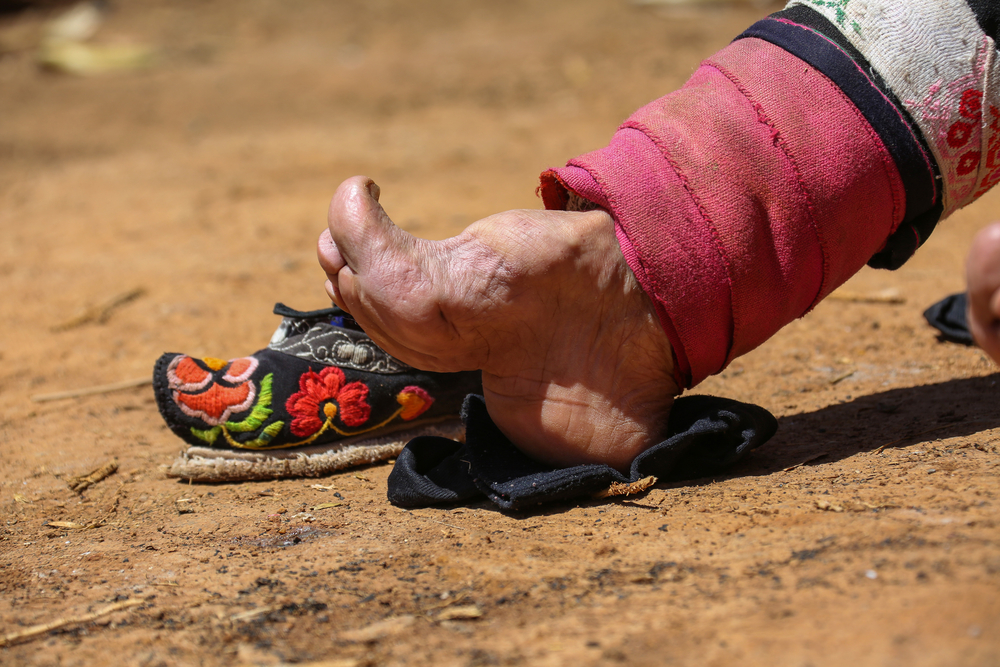
Chinese foot binding, also known as lotus feet, was a practice that involved tightly binding the feet of young girls and women in China for centuries. It was primarily practiced among the upper classes and was considered a symbol of beauty and status. Foot binding had significant social and cultural implications but caused severe physical deformity and lifelong disability for those subjected to it.
Purpose: Foot binding was primarily done to achieve the ideal of “lotus feet,” which were small, delicate, and considered highly desirable in traditional Chinese beauty standards. It was believed that small feet represented femininity, elegance, and social status. Foot binding was seen as a way for women to improve their marriage prospects and gain social acceptance.
Process: Foot binding typically began during childhood, usually between the ages of 4 and 9. The process involved tightly binding the feet with cloth or bandages, gradually pulling the toes inward and bending the arch of the foot. This caused the foot bones to break and deform, resulting in a characteristic “lotus” or “golden lotus” shape. The bindings were regularly tightened, causing immense pain and restricting foot growth.
Consequences: Chinese foot binding caused severe and irreversible physical deformities and disabilities. The feet became permanently misshapen, with the toes curled under and the arch of the foot raised. Walking was extremely difficult and painful, and women with bound feet often had to hobble or use walking aids. The deformity also affected balance and posture, leading to additional health issues such as back pain and joint problems.
Social Significance: Chinese foot binding had profound social implications. Women with bound feet were considered more desirable for marriage, as it signified their adherence to societal norms and demonstrated their commitment to beauty standards. Unbound feet were often seen as undesirable and a reflection of lower social status. The practice was deeply ingrained in Chinese culture and influenced various aspects of life, including literature, art, and social interactions.
Decline and Abolition: Chinese foot binding began to decline in the late 19th and early 20th centuries due to changing social attitudes and increased exposure to Western ideas. Efforts by reformers, activists, and government initiatives contributed to the gradual abolition of foot binding. The practice was officially banned in China in the early 20th century, although it continued in some rural areas for some time.
Chinese foot binding is now recognized as a harmful and oppressive practice, reflecting the subjugation and control of women in traditional Chinese society. Its long-term physical and psychological effects on those who underwent the procedure were significant. Today, foot binding is viewed as a historical relic, studied as part of understanding the cultural and social dynamics of the past.
Chinese Foot Binding FAQ’s:
1. What was Chinese foot binding?
Foot binding (缠足, chánzú) was a traditional Chinese practice in which the feet of young girls were tightly bound with cloth strips to restrict growth and reshape them into a small, arched form known as “lotus feet.” The ideal size was about 3 inches (7–8 cm) long—the so-called “golden lotus.” The practice lasted roughly 1,000 years, from around the 10th century until the early-to-mid 20th century.
2. When and how did it start?
Chinese foot binding most likely began in the 10th century during the Southern Tang dynasty (or late Tang/Five Dynasties period). The popular origin story involves a court dancer named Yao Niang (or Yaoniang), who bound her feet into a crescent-moon shape and danced for Emperor Li Yu on a golden lotus platform. The practice started among court entertainers and elites in the Song dynasty (960–1279) and gradually spread to wider social classes. The earliest archaeological evidence comes from tombs dating to the mid-13th century.
3. How was the process done?
Girls typically began the process between ages 4–8 (most commonly 5–6). The four smaller toes on each foot were broken and folded under the sole toward the heel, while the big toe remained. Long strips of cloth (often cotton or silk) were tightly wrapped to force the arch upward into a high, curved shape. The bandages were changed and tightened regularly (sometimes every few days or weekly). The process caused intense pain, swelling, infection risk, and permanent deformity. Binding continued for years until the feet stopped growing.
4. Why was it practiced?
Multiple overlapping reasons for Chinese foot binding existed:
- Beauty and status: Tiny feet were considered highly attractive and a mark of refinement and femininity.
- Marriage prospects: Bound feet often improved a girl’s chances of marrying into a higher-status family (especially among Han Chinese elites).
- Social distinction: It signaled that a family was wealthy enough that the daughter did not need to perform heavy outdoor labor.
- Cultural/ethnic identity: After the Mongol conquest, it became associated with Han Chinese identity in contrast to non-Han groups.
- Economic factors (emphasized by recent research): In many rural areas it helped keep young girls sitting still to perform valuable handwork such as spinning, weaving, and other textile production that contributed to household income.
It was never universal—Manchu women (the Qing ruling ethnic group), Hakka women, and some other groups generally did not practice it.
5. How common was it?
By the 19th century, estimates suggest 40–50% of Chinese women had bound feet overall, rising to nearly 100% among upper-class Han Chinese women in many regions. In some rural surveys from the early 20th century, rates among older women exceeded 90–95%. Prevalence varied significantly by region, class, and ethnicity.
6. What were the physical and health effects?
The practice permanently deformed the feet: bones were broken, the arch was forced into an extreme angle, and the foot became much smaller and less functional. Women typically walked with a distinctive, unstable gait and often needed support. Common problems included chronic pain, infections, open sores, gangrene, arthritis, limited mobility, and higher risk of falls. Some girls died from infection during the initial binding process. Many women required lifelong care for their feet and bandages.
7. When and why did it end?
Attempts to ban Chinese foot binding occurred under the Manchus (17th century) and later Qing rulers, but they largely failed. Serious decline began in the late 19th and early 20th centuries due to:
- Campaigns by Western missionaries and Chinese reformers who viewed it as backward and harmful.
- Nationalist ideas linking unbound feet to a strong, modern China.
- Official bans after the 1911–1912 revolution (Republic of China) and stronger enforcement under the Communist government after 1949.
- Economic changes, especially the rise of factory textile production, which reduced the value of girls’ domestic hand labor.
The practice had largely died out by the 1930s–1940s in most areas, though isolated cases continued into the 1950s. The last specialized lotus-shoe factories closed in the late 20th century.
8. Did men have anything similar?
No. Chinese foot binding was almost exclusively practiced on girls and women. There was no parallel custom for males.
9. Are there still women with bound feet today?
A very small number of elderly women (mostly born in the 1920s–1930s or earlier) who underwent Chinese foot binding as children are still alive, primarily in rural areas. Their numbers are rapidly declining. Museums in China (such as the Three-Inch Golden Lotus Museum) preserve shoes, artifacts, and historical information about the practice.
10. How is foot binding viewed today?
It is universally regarded in modern China and by historians as a harmful and oppressive custom that caused significant suffering. It serves as a historical example of extreme beauty standards, gender norms, and the intersection of culture, economics, and body modification. Academic research continues to refine understanding of its economic and social drivers beyond pure aesthetics.