
The Kinetic Wedge is an extension on the end of a foot orthotic that is designed to treat functional hallux limitus
A kinetic wedge is a modification used in a foot orthotic to change how the big toe (hallux) and first metatarsal move during walking. It is most commonly used to encourage the first metatarsal to plantarflex (move downward) and make it easier for the big-toe joint to dorsiflex as the body moves over the foot.
The wedge works by placing material under the second through fifth metatarsal heads while leaving a cut-out or lower area beneath the first metatarsal head. In effect, the first metatarsal has more room to move downward relative to the other metatarsals. This can reduce resistance at the first metatarsophalangeal (1st MTP) joint and facilitate the foot’s windlass mechanism during propulsion.
What is the Kinetic Wedge used for?
A kinetic wedge may be incorporated into an orthotic when someone has functional hallux limitus—where the big toe has reasonable movement when the foot isn’t bearing weight but becomes restricted during standing or walking. It may also be considered when improving first-ray function and big-toe engagement during push-off is desirable.
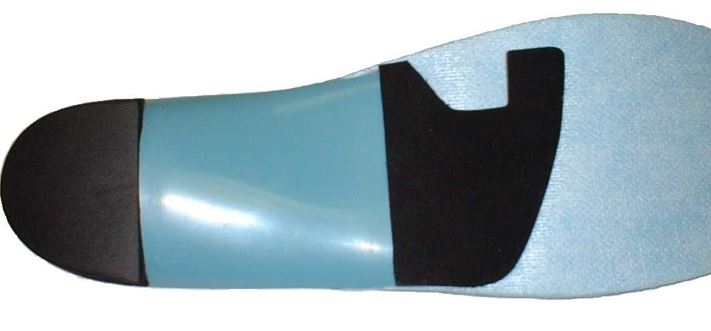
The basic idea is:
Without the wedge: pressure beneath the first metatarsal can restrict its plantarflexion → the 1st MTP joint may have difficulty dorsiflexing → propulsion through the big toe can be impaired.
With a kinetic wedge: the first metatarsal head is relatively unloaded → the first ray can plantarflex more easily → the hallux can dorsiflex more readily → the windlass mechanism can operate more effectively.
It is somewhat similar in concept to a first-ray cut-out, although the construction is different. A kinetic wedge generally creates the effect by adding material beneath metatarsals 2–5 rather than simply removing orthotic material beneath the first metatarsal.
Importantly, it isn’t appropriate for every painful big-toe joint. In structural hallux rigidus, where motion is restricted by arthritic or bony changes, increasing motion may not be the objective; a clinician may instead use modifications designed to restrict or redistribute motion and pressure.